- A Natural Flooring Material That Has Supported Japanese Life for Over 1,000 Years
Tatami is a traditional Japanese flooring material made from natural materials such as rice straw and igusa rush. It is an integral part of Japanese life and culture and a central element of Japanese-style spaces, including tea rooms. The custom of removing shoes indoors is also thought to be connected to keeping tatami clean and beautiful. Although ancient Japan adopted many cultural influences from China, tatami developed over centuries as a tradition unique to Japan.
The history of tatami in its recognizable form dates to the Heian period (794–1185), although mat-like floor coverings appear in the earlier Kojiki chronicle. Tatami originally served as portable bedding placed on wooden floors rather than as wall-to-wall flooring. Its thickness and border patterns reflected the user’s rank, and it was reserved for the elite. Jisho-ji Temple’s shoin-style Togu-do, built by Ashikaga Yoshimasa in 1485, is associated with an early room fully covered in tatami. Tatami became widespread among ordinary people during the Edo period (1603–1868), influenced in part by tea-ceremony culture, in which the tatami room offered a space where farmers, samurai, and aristocrats could meet as equals. By the late Edo period, tatami making had become an established profession.
Tatami also comes with a distinctive rule of etiquette: do not step on the border. In ancient Japan, border patterns represented noble rank, and stepping on them was considered disrespectful.


The Story of Tatami
Where Grass Becomes Architecture



Few materials have shaped Japanese daily life as profoundly as tatami. Made almost entirely from natural grasses, tatami has been used for more than a thousand years and remains one of the defining elements of Japanese interiors.
What many people do not realize is that tatami was not originally used as permanent flooring. Early tatami were thinner, portable mats that could be folded, moved, and arranged as needed. Over time, they evolved alongside Japanese architecture, eventually becoming the foundation of the spaces we recognize today.
Through the stories and demonstrations of a dedicated tatami maker, guests are introduced to the history, materials, and techniques behind one of Japan's oldest living traditions. As he explains how tatami adapted to changing lifestyles and architecture over the centuries, visitors gain a deeper appreciation for a material that quietly shaped the Japanese way of living.
After observing the production process and handling the natural materials themselves, participants create a small tatami coaster to take home. More than a souvenir, it serves as a reminder that one of Japan's oldest cultural traditions began with something as simple as grass.
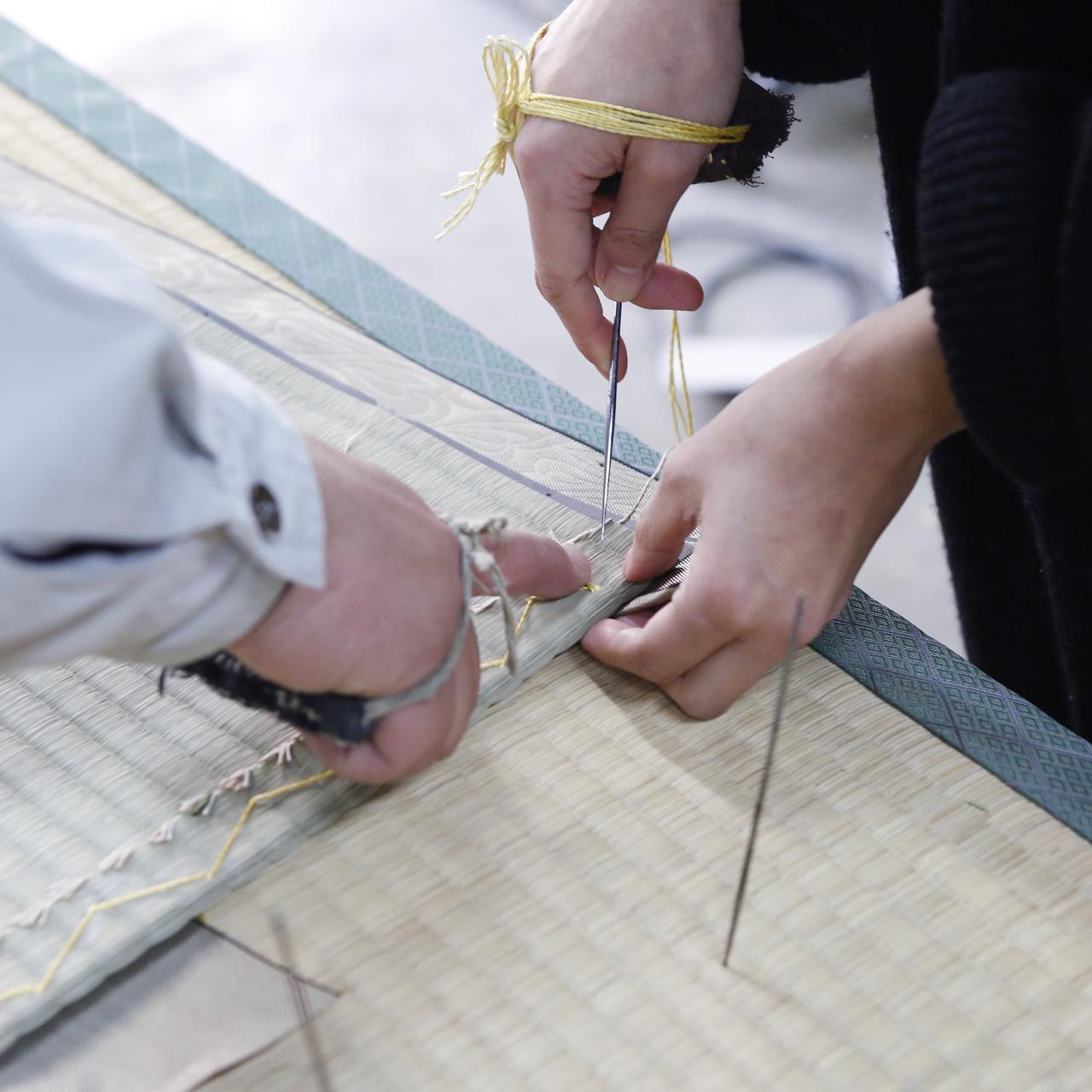


- Kyo-Tatami Craftspeople Who Still Sew Tatami by Hand
A tatami craftsperson does more than make mats. The work also involves measuring the room, designing the layout, and adjusting each mat to fit. As tatami craftspeople often say, no room is perfectly square, so every mat must be sized to accommodate slight differences in the lengths and angles of the room.
Tatami consists of three main parts: the tatami-doko core, the woven tatami-omote surface, and the tatami-beri border that secures the surface to the core. Craftspeople carefully sew these layers together with thick, specialized needles. Modern cores may use synthetic materials, but traditional cores were made from compressed rice straw; a single mat could contain roughly a small truckload of straw.
Most tatami is now made by machine. Traditionally, however, craftspeople stitched through material five centimeters thick or more using a thick, rigid needle. This full-body work demands both strength and precision. The craftspeople at Ohta Tatami are among the few who can still complete tatami entirely by hand-sewing.
Tatami surfaces become worn with use, but a mat can be refreshed by turning the surface over. Later, the tatami-omote can be replaced while the tatami-doko core is retained, extending the mat’s life again.
Tatami-omote was traditionally woven from igusa rush. Today, washi and other manufactured materials are also available.
Ohta Tatami recommends materials suited to each room and to the lifestyle of the people who will use it.
- He says
“While remembering the essential things that never change, it is also important to embrace what is new. The pursuit of fresh sensibilities through change is itself part of an enduring tradition.
“As the role of tatami in Japan changes dramatically, Ohta Tatami is broadening its creative practice with the aim of building a culture in which tatami is loved even more.”



- Kyo-Tatami Craftsperson
- Shigeki Ohta
- Ohta Tatami is a specialist tatami shop established in Nishijin, Kyoto, in 1939. Its craftspeople make tatami one by one by hand using natural materials sourced in Japan. They are certified first-class tatami production technicians with expert knowledge of traditional tatami making.
Access
20 minutes by taxi from Kyoto Station
The marker shows the approximate area.
The exact address will be provided when your reservation is confirmed.
Experiences
- Reserve
Kyoto Tatami Studio Tour & Coaster Experience
21,500 JPY / personVisit a working tatami studio in Nishijin, Kyoto, and discover how this traditional flooring is constructed from carefully layered materials and finished by skilled hands. Observe the artisan’s normal work while learning how tatami techniques, tools, and materials have evolved over time.
Then use washi tatami material to create one original coaster measuring approximately 10 × 10 cm. The 90-minute experience combines a close look at an active studio with an approachable hands-on project that you can take home.
